
What Is TB-500, and Is It the Same as Thymosin Beta-4?
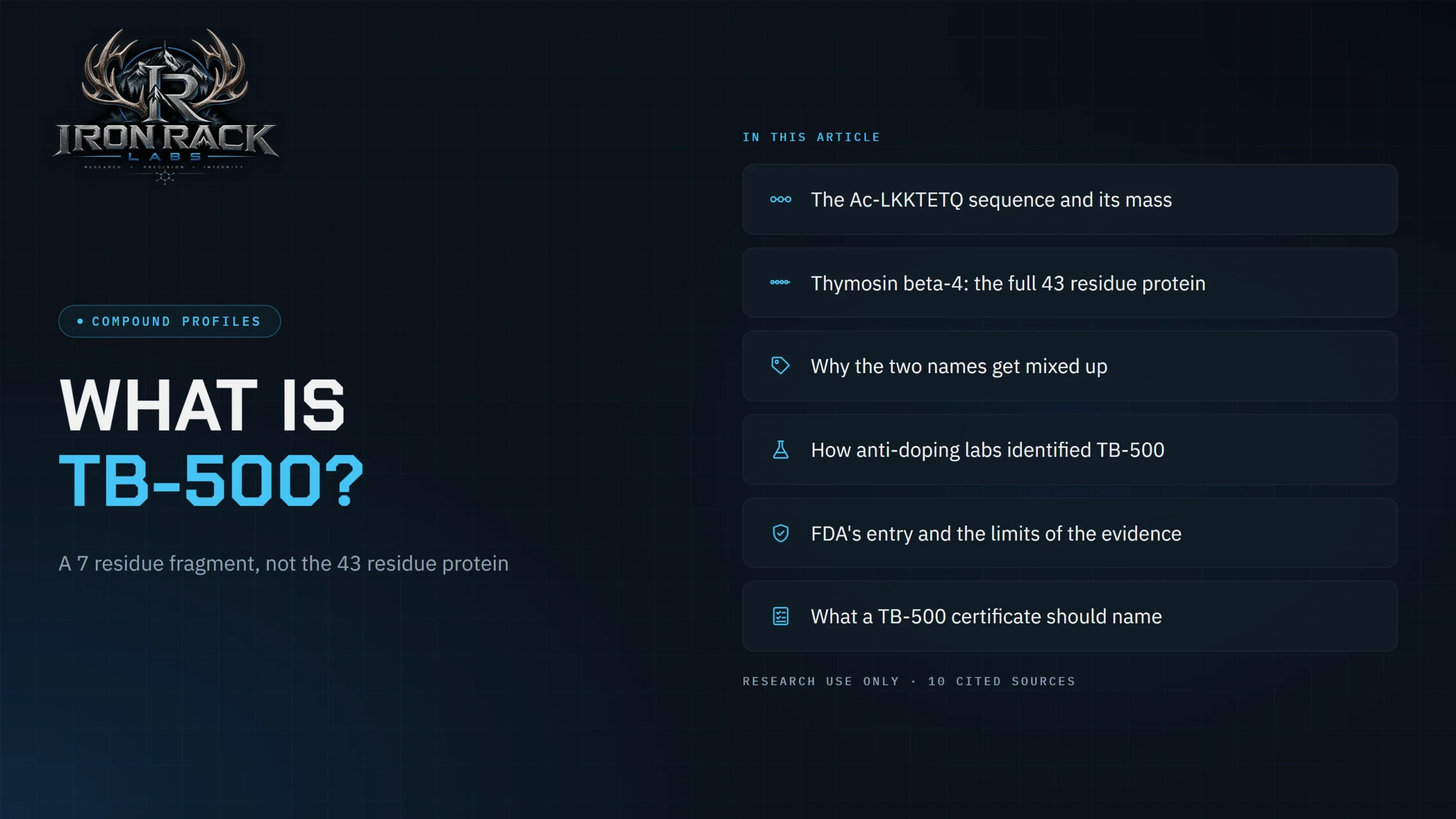
No. Thymosin beta-4 is a 43 amino acid protein. TB-500, as identified by anti-doping laboratories and as listed by FDA, is a 7 residue synthetic fragment of it, Ac-LKKTETQ, covering residues 17 to 23 with an acetyl group added to the front.
The two share seven residues and a name. The full protein weighs more than five times as much as the fragment, so they are different molecules with different identities on a certificate.
What is TB-500? The short answer is that it depends on who is labeling it, and that is the problem this article untangles. It sets out the fragment’s sequence and mass, what thymosin beta-4 is, why the two names get mixed up, how the published research on each is made up, and what a certificate should name. TB-500 is also one half of the BPC-157 / TB-500 blend, and BPC-157 has its own profile in our article on what BPC-157 is.
Scope: this article summarizes published analytical and laboratory research. It does not describe or recommend use in people or animals, and the research use policy sets out how materials on this site are supplied.
What is TB-500, chemically?
The clearest identification comes from anti-doping chemistry. A 2012 analytical study by Esposito and colleagues used liquid chromatography with high resolution mass spectrometry to identify the N-terminally acetylated 17 to 23 fragment of human thymosin beta-4, Ac-LKKTETQ, in a product sold as TB-500, then made the same peptide by solid-phase synthesis to confirm it.
- Leu
- Lys
- Lys
- Thr
- Glu
- Thr
- Gln
A second 2012 doping control study by Ho and colleagues reached the same description: the key ingredient of TB-500 is the peptide LKKTETQ with artificial acetylation of the N-terminus, taken from the region of thymosin beta-4 associated with actin binding. FDA uses the same identity. Its page of bulk drug substances that may present significant safety risks, current as of April 22, 2026, lists the substance as thymosin beta-4, fragment (LKKTETQ), also known as TB-500.
Written out, Ac-LKKTETQ is C38H68N10O14, with an average molecular weight of about 889.0 and a monoisotopic mass of 888.49. The highlighted residues are the LKKTET stretch usually described as the actin binding motif.
What thymosin beta-4 is
Thymosin beta-4 is a small protein that was found long before anyone sold a fragment of it. A 1981 sequencing study by Low, Hu and Goldstein determined its full structure from calf thymus: 43 amino acid residues, with the N-terminus blocked by an acetyl group. The human sequence in UniProt entry P62328 gives the same mature 43 residue chain, starting with an N-acetylserine.
Its best established role is structural. A 1991 biochemical study by Safer, Elzinga and Nachmias showed that thymosin beta-4 is identical to an actin-sequestering peptide from platelets, binding actin monomers one to one and inhibiting their polymerization. A 2001 review by Huff and colleagues describes the beta-thymosins as the main intracellular actin-sequestering peptides, present at high concentration in almost every cell.
Thymosin beta-4
The full protein: 43 residues, acetylated at the N-terminus, average mass close to 4,963 calculated from its sequence.
TB-500
Residues 17 to 23 only, LKKTETQ, with an acetyl group added to the leucine. Average mass about 889.
Ac-SDKP
A different fragment, the first four residues, which the 2001 review lists among the forms with effects attributed to them.
| Property | Thymosin beta-4 | TB-500 (Ac-LKKTETQ) |
|---|---|---|
| Length | 43 residues | 7 residues |
| Where it comes from | Full protein, found in cells | Synthetic copy of residues 17 to 23 |
| N-terminus | Acetylated serine | Acetylated leucine, added in synthesis |
| Average molecular weight | About 4,963 | About 889.0 |
| Main mass spectrometry signal | Multiply charged ions | Protonated ion near m/z 889.5, doubly charged near 445.3 |
Why the names get mixed up
The confusion is built into the names. “TB” reads as thymosin beta, so the name itself suggests the whole protein. Two points are often missed.
First, anti-doping rules group them together. USADA’s summary of the 2018 Prohibited List notes that thymosin-beta-4 and its derivatives, for example TB-500, were added as examples of prohibited growth factors under section S2.3. That is a rule about a family of substances. It does not mean the two are the same molecule.
Second, the identity of TB-500 was established by analysis, not by its label. Esposito and colleagues had to work out what the product contained before they could describe it, which is a reminder that a product name on its own settles nothing.
A result reported for full-length thymosin beta-4 is a result on a 43 residue protein. It says nothing about a 7 residue fragment, and the reverse is also true.
How the published research on each is made up
The two names lead to two very different bodies of literature.
- Thymosin beta-4: biochemistry first. Much of the foundational work is actin biochemistry, like the 1991 and 2001 papers above, followed by cell and animal studies.
- Thymosin beta-4: registered human studies. The full protein has been tested in registered clinical trials. One example is a completed Phase 2 study, NCT00832091, with 72 participants, sponsored by RegeneRx Biopharmaceuticals.
- TB-500: mostly detection chemistry. Much of what is published under the TB-500 name is doping control analysis. Besides the two 2012 studies, a 2013 method by Kwok and colleagues detects seven peptides, including N-acetylated LKKTETQ as the active ingredient of TB-500, in horse plasma by liquid chromatography and high resolution mass spectrometry.
This article deliberately does not summarize reported biological effects of either molecule. The 2001 review itself noted that nothing was known about the molecular mechanisms behind effects attributed to extracellular beta-thymosins, and a finding in a cell or animal model describes that model only.
Where the evidence stops
For the fragment, the gap between what is claimed and what is documented is wide.
- No human exposure data for the fragment. FDA’s entry for thymosin beta-4, fragment (LKKTETQ) states that the agency has not identified any human exposure data for drug products containing it, and that it lacks information on whether it would cause harm in people. The entry also notes a possible risk of immunogenicity.
- Protein data do not transfer. Clinical trials of full-length thymosin beta-4 tested the 43 residue protein. They are not evidence about Ac-LKKTETQ.
- Prohibited in sport. Thymosin-beta-4 and its derivatives, including TB-500, are listed under S2.3 of the anti-doping Prohibited List, as USADA’s summary above sets out.
FDA revises its page, so check the current version before relying on any of these entries.
What a TB-500 certificate should name
Because the name is ambiguous, the certificate has to do the identifying. These are the fields to read against the chemistry above. The guide on how to read a certificate of analysis covers the general layout.
- The molecule named explicitly, fragment or full protein
- Sequence stated, for the fragment Ac-LKKTETQ
- Residue count and N-terminal acetylation stated
- Expected mass matching that molecule, about 889 for the fragment
- Measured mass reported next to the expected value
- HPLC method, column and detection wavelength named
- Lot number on the certificate matches the vial label
- Testing laboratory and test date identified
A certificate that says only “TB-500” or only “thymosin beta-4” with no sequence cannot be checked against either molecule. The BPC-157 / TB-500 Blend listing sits in the peptide blends category, and each component is reported separately on its certificate. Iron Rack Labs publishes lot matched certificates in the certificate of analysis library, and the quality and testing page sets out the methods behind them: RP-HPLC for purity and LC-MS for identity. Pick a blend lot there and check that its TB-500 entry names Ac-LKKTETQ, that the measured mass sits near 889, and that the chromatogram names its detection wavelength.
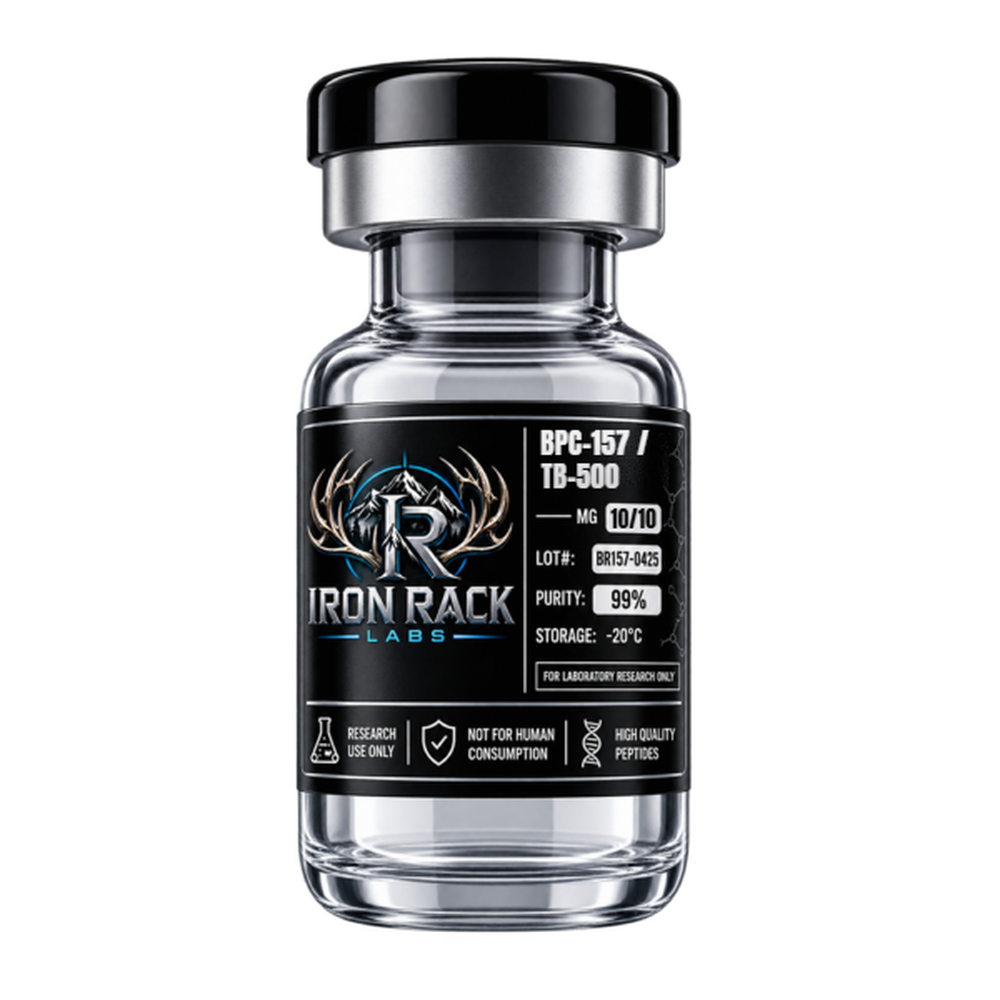
BPC-157 / TB-500 Blend
BPC-157 with the TB-500 fragment Ac-LKKTETQ, supplied for research use only. Each component is reported separately on a lot matched certificate in the certificate of analysis library.
View BPC-157 / TB-500 Blend- TB-500 is Ac-LKKTETQ, residues 17 to 23 of thymosin beta-4
- Thymosin beta-4 is the full 43 residue, N-acetylated protein
- The fragment weighs about 889; the protein about 4,963
- The fragment’s identity was established by anti-doping analysis
- Protein trial data are not evidence about the fragment
- A certificate should name the sequence, not just the product name
Frequently asked questions
TB-500 is a synthetic 7 residue peptide, Ac-LKKTETQ, matching residues 17 to 23 of thymosin beta-4 with an acetyl group added to the N-terminus. Anti-doping laboratories identified this fragment in products sold as TB-500, and FDA lists it as thymosin beta-4, fragment (LKKTETQ), also known as TB-500. Its average molecular weight is about 889.
No. Thymosin beta-4 is a 43 amino acid protein with an average mass close to 4,963. TB-500 is a 7 residue fragment of it with a mass of about 889. They share one short stretch of sequence, but they are different molecules, and a result on one is not a result on the other.
Because its sequence, LKKTETQ, is copied from positions 17 to 23 of thymosin beta-4. That stretch includes the LKKTET motif usually associated with the protein’s actin binding. The acetyl group on the front of TB-500 is added during synthesis, so the fragment is not simply a piece cut from the natural protein.
It should name the molecule explicitly, state the sequence Ac-LKKTETQ and the N-terminal acetylation, and report the measured mass next to the expected value of about 889. It should also name the HPLC method behind any purity figure, the lot number, the testing laboratory and the test date. A product name alone cannot be checked.
FDA lists thymosin beta-4, fragment (LKKTETQ), also known as TB-500, on its page of bulk drug substances that may present significant safety risks. The entry notes a possible risk of immunogenicity and states that FDA has not identified any human exposure data for products containing it. FDA revises that page, so check the current version.
- Esposito S, Deventer K, Goeman J, Van der Eycken J, Van Eenoo P, 2012. Analytical study. Drug Testing and Analysis, 4(9), 733 to 738. DOI
- Ho EN, Kwok WH, Lau MY, Wong AS, Wan TS, Lam KK, Schiff PJ, Stewart BD, 2012. Analytical study. Journal of Chromatography A, 1265, 57 to 69. DOI
- Certain Bulk Drug Substances for Use in Compounding that May Present Significant Safety Risks. U.S. Food and Drug Administration, content current as of April 22, 2026. View source
- Low TL, Hu SK, Goldstein AL, 1981. Sequencing study. Proceedings of the National Academy of Sciences of the USA, 78(2), 1162 to 1166. DOI
- Thymosin beta-4, entry P62328. UniProt Knowledgebase. View source
- Safer D, Elzinga M, Nachmias VT, 1991. Biochemical study. Journal of Biological Chemistry, 266(7), 4029 to 4032. PubMed
- Huff T, Müller CS, Otto AM, Netzker R, Hannappel E, 2001. Review. International Journal of Biochemistry and Cell Biology, 33(3), 205 to 220. DOI
- 2018 Prohibited List: Summary of Major Changes. U.S. Anti-Doping Agency, October 2, 2017. View source
- Registry record NCT00832091. ClinicalTrials.gov, Phase 2, completed. View source
- Kwok WH, Ho EN, Lau MY, Leung GN, Wong AS, Wan TS, 2013. Analytical study. Analytical and Bioanalytical Chemistry, 405(8), 2595 to 2606. DOI
Journal article titles are not reproduced in this list. Each entry links to the original record.
This article is general educational information about published laboratory research. It is not medical, legal or regulatory advice, and nothing in it describes or recommends the use of any compound in people or animals. Materials supplied by Iron Rack Labs are for research use only: not for human or veterinary use, not for diagnostic use, and not for use as a food, drug, dietary supplement or cosmetic. Sale is restricted to adults aged 18 or over. Iron Rack Labs publishes this Journal and supplies research materials, and nothing in this article is an offer, a recommendation or an instruction for use. See the compliance overview for details.