
What Is MOTS-c? The Mitochondrial-Derived Peptide Explained

MOTS-c is a 16 amino acid peptide encoded in mitochondrial DNA, inside the gene for the 12S ribosomal RNA. Its sequence is MRWQEMGYIFYPRKLR, its free base formula is C101H152N28O22S2, and it was first described in 2015 by a research group working in cultured cells and mice.
Most peptides studied at the bench are encoded in the nucleus. MOTS-c is not, and that origin is why it draws attention.
This article answers what is MOTS-c in chemical terms: its sequence, its mass, its place in the mitochondrial genome, how the published research is built, where the evidence stops and what a certificate should name. If lot records are new to you, our guide on how to read a certificate of analysis is a useful companion.
Scope: this article summarizes published laboratory and animal research. It does not describe or recommend use in people or animals, and the research use policy sets out how materials on this site are supplied.
What is MOTS-c, chemically?
MOTS-c is a linear peptide of 16 residues. The UniProt reference entry for MOTS-c, accession A0A0C5B5G6, gives the sequence as MRWQEMGYIFYPRKLR, a mass of 2,175 Da and the mitochondrial gene MT-RNR1 as its source. The name is short for mitochondrial open reading frame of the 12S rRNA-c.
- Met
- Arg
- Trp
- Gln
- Glu
- Met
- Gly
- Tyr
- Ile
- Phe
- Tyr
- Pro
- Arg
- Lys
- Leu
- Arg
Methionine sits at positions 1 and 6, and those two sulfur atoms are the S2 in the formula. Methionine is prone to oxidation, and each added oxygen atom shifts the mass by about 16 Da, one reason a mass spectrometry identity check matters here. The chain also carries three arginines and one lysine against a single glutamate, so it is strongly basic.
An FDA evaluation of MOTS-c related bulk drug substances, dated May 11, 2026, gives the free base formula as C101H152N28O22S2 with a molecular weight of 2174.6 g/mol. The monoisotopic mass calculated from that formula is 2173.11 Da, the figure a high resolution mass spectrum reports for the lightest isotope peak.
| Property | Value | Basis |
|---|---|---|
| Length | 16 residues | UniProt entry |
| Sequence | MRWQEMGYIFYPRKLR | UniProt entry |
| Encoding gene | MT-RNR1 (12S rRNA) | UniProt entry |
| Formula, free base | C101H152N28O22S2 | FDA evaluation, 2026 |
| Average molecular weight, free base | 2174.6 g/mol | FDA evaluation, 2026 |
| Monoisotopic mass, free base | 2173.11 Da | Calculated from the formula |
| Molecular weight, acetate salt | About 2234.64 g/mol | FDA evaluation, 2026 |
Where MOTS-c comes from
The peptide was reported in a 2015 discovery study by Lee and colleagues in Cell Metabolism. The group started from humanin, an earlier peptide traced to a short open reading frame in mitochondrial DNA, and reasoned that more might exist. They reported a short open reading frame within the 12S rRNA gene that encodes the 16 residue sequence now called MOTS-c.
That places MOTS-c in a small group known as mitochondrial derived peptides. The mitochondrial genome is compact and mostly codes for respiratory chain proteins and RNAs, so a peptide inside a ribosomal RNA gene was unexpected.
The discovery work was carried out in cultured cells and in mice. At the molecular level, the authors described an action on the folate cycle and the linked de novo purine synthesis pathway, followed by activation of AMPK, the AMP activated protein kinase. Those statements describe signaling in cell and mouse models and nothing further.
A 2018 cell study by Kim and colleagues added a second thread. In cultured cell lines under metabolic stress, such as glucose restriction, MOTS-c was reported to move into the nucleus in an AMPK dependent manner and to interact with stress responsive transcription factors, including NRF2.
Why the names and forms get mixed up
The same 16 residues travel under several labels: MOTS-c, MOTSc and the long form of the name. The FDA evaluation notes that naming in the nomination did not follow INN, IUPAC or USAN conventions, and it assessed two forms because the nomination did not make clear which one was intended.
Free base
The peptide with no counterion. This is the form that the formula C101H152N28O22S2 and the 2174.6 g/mol figure describe.
Acetate salt
The peptide paired with acetate counterions. FDA gives its molecular weight as about 2234.64 g/mol, so the weight of material and the weight of peptide are not the same number.
CB4211
The named intervention in a completed phase 1 registry record. The record does not name MOTS-c as its intervention, so it is not a MOTS-c record.
That registry entry, ClinicalTrials.gov record NCT03998514, lists a phase 1 study sponsored by CohBar, Inc., with a status of completed and an actual enrollment of 88. Data on one named molecule do not transfer to another.
Form also affects the arithmetic: a purity figure and a peptide content figure answer different questions, as our explainer on what an RP-HPLC purity number actually measures sets out.
How the published MOTS-c research is made up
The MOTS-c research literature is almost entirely preclinical, and it sorts into three kinds of work.
- Cell studies. Cultured cell lines used to examine signaling, such as the folate cycle and AMPK work in the 2015 discovery study and the nuclear translocation work in 2018.
- Rodent studies. Mouse models, including diet models and aged animals. A 2021 study by Reynolds and colleagues in Nature Communications worked in mice aged 2, 12 and 22 months. Findings of this kind belong to the strain, diet and age examined.
- Measurements of the native peptide. The same 2021 paper measured endogenous MOTS-c in skeletal muscle and plasma samples from 10 sedentary young men, collected before and after a single cycling session.
A study that measures native MOTS-c in human samples says nothing about what supplied MOTS-c would do. The published human data so far are of the first kind.
Each finding belongs to its model: a cell line, a mouse strain, a diet, an age. None of it establishes anything in people.
Where the evidence stops
FDA’s 2026 evaluation is the clearest summary of the gaps. Its reviewers found nonclinical data limited to in vitro work and rodent models, no identified molecular target, and no in vivo pharmacokinetic or toxicology studies of the kinds the agency looks for, including genotoxicity and carcinogenicity. They found no human clinical studies of either form. One in vitro study they reviewed reported that MOTS-c breaks down quickly in human blood.
On quality, FDA described MOTS-c free base as not well characterized from a physical and chemical standpoint, citing missing data on impurities, aggregates, endotoxins and bioburden. The document proposes not adding either form to the 503A bulks list. It also states that this is a proposal and that the agency decides only after advisory committee input and its other reviews. That process was still open when this article was written, so check the current FDA record.
In sport, MOTS-c is named explicitly. The WADA Prohibited List places it in section S4.4.1, among activators of AMP activated protein kinase. The page was last updated October 16, 2026. USADA’s athlete advisory on the 2025 list, published October 16, 2024, reported its addition and described it as an experimental peptide not approved for human therapeutic use.
MOTS-c has a defined sequence, a defined genomic origin and a body of cell and mouse work. It has no established human pharmacology, no identified binding target and no approval as a drug.
What a MOTS-c certificate should name
Because the sequence and formula are fixed, a MOTS-c certificate can be checked line by line.
- The name MOTS-c and the full sequence MRWQEMGYIFYPRKLR
- A lot number that matches the vial label
- The form tested, free base or a named salt such as acetate
- LC-MS identity data giving observed and expected mass
- An expected mass near 2174.6 average or 2173.11 monoisotopic for the free base
- RP-HPLC purity data with its chromatogram and detection wavelength
- The test date and the method or laboratory reference
- The storage temperature for the lyophilized material
The storage line matters for reasons set out in our article on cold chain and why the storage temperature is on the label. The MOTS-C 10mg listing sits in the mid chain peptides category, and each lot is matched to a record in the certificate of analysis library. Iron Rack Labs describes its methods on the quality and testing page: RP-HPLC for purity and LC-MS for identity. Pick a MOTS-c lot in the library and check that the sequence, the observed mass and the stated form match what this article sets out.
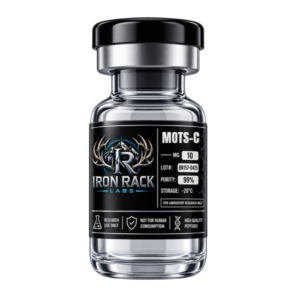
MOTS-C 10mg
MRWQEMGYIFYPRKLR, supplied for research use only. Each lot has a matched certificate in the certificate of analysis library.
View MOTS-C 10mg- MOTS-c is a 16 residue peptide encoded in the mitochondrial 12S rRNA gene
- Its free base formula is C101H152N28O22S2, at 2174.6 g/mol
- It was first described in a 2015 discovery study in cultured cells and mice
- The literature is cell and rodent work, plus measurement of the native peptide
- FDA’s 2026 evaluation found no human clinical studies and no identified target
- A certificate should name the sequence, the form, the observed mass and the lot
Frequently asked questions
MOTS-c is a 16 amino acid peptide encoded in human mitochondrial DNA, within the 12S ribosomal RNA gene. Its sequence is MRWQEMGYIFYPRKLR and its free base formula is C101H152N28O22S2, with a molecular weight of 2174.6 g/mol. It was first described in a 2015 discovery study in cultured cells and mice. The name is short for mitochondrial open reading frame of the 12S rRNA-c.
A mitochondrial derived peptide is a short peptide encoded by a small open reading frame in the mitochondrial genome rather than in the nucleus. Humanin was an earlier example, and MOTS-c, reported in 2015, is another. The group is defined by where the coding sequence sits, not by any shared activity, so membership says nothing about what an individual peptide does.
Not with supplied MOTS-c. FDA’s 2026 evaluation found no human clinical studies of MOTS-c free base or MOTS-c acetate. Published human data measure the body’s own MOTS-c, for example in muscle and plasma samples collected before and after a single cycling session. Measuring a native peptide does not answer what supplied material would do.
Yes. MOTS-c is named on the WADA Prohibited List under S4, hormone and metabolic modulators, as an example of an activator of AMP activated protein kinase. It was added for the 2025 list, and USADA described it at the time as an experimental peptide not approved for human therapeutic use. WADA revises the list every year, so check the current version.
A MOTS-c certificate should name the peptide, its full 16 residue sequence, the lot number and whether the material is the free base or a salt such as acetate. It should report LC-MS identity data with observed and expected mass, near 2174.6 average or 2173.11 monoisotopic for the free base, and RP-HPLC purity data with its chromatogram.
- Mitochondrial-derived peptide MOTS-c, UniProtKB entry A0A0C5B5G6 (MOTSC_HUMAN). UniProt. View source
- FDA Evaluation of MOTS-c Related Bulk Drug Substances, MOTS-c (free base) and MOTS-c acetate. U.S. Food and Drug Administration, dated May 11, 2026. View source
- Lee C, Zeng J, Drew BG, Sallam T, Martin-Montalvo A, Wan J, Kim SJ, Mehta H, Hevener AL, de Cabo R, Cohen P, 2015. Discovery study. Cell Metabolism, 21(3), 443 to 454. DOI
- Kim KH, Son JM, Benayoun BA, Lee C, 2018. Cell study. Cell Metabolism, 28(3), 516 to 524.e7. DOI
- Registry record NCT03998514. ClinicalTrials.gov, first posted June 26, 2019. View source
- Reynolds JC, Lai RW, Woodhead JST, Joly JH, Mitchell CJ, Cameron-Smith D, Lu R, Cohen P, Graham NA, Benayoun BA, Merry TL, Lee C, 2021. Rodent study. Nature Communications, 12(1), 470. DOI
- The Prohibited List. World Anti-Doping Agency, last updated October 16, 2026. View source
- Athlete Advisory: What’s New on the 2025 WADA Prohibited List? U.S. Anti-Doping Agency, October 16, 2024. View source
Journal article titles are not reproduced in this list. Each entry links to the original record.
This article is general educational information about published laboratory research. It is not medical, legal or regulatory advice, and nothing in it describes or recommends the use of any compound in people or animals. Materials supplied by Iron Rack Labs are for research use only: not for human or veterinary use, not for diagnostic use, and not for use as a food, drug, dietary supplement or cosmetic. Sale is restricted to adults aged 18 or over. Iron Rack Labs publishes this Journal and supplies research materials, and nothing in this article is an offer, a recommendation or an instruction for use. See the compliance overview for details.