
What is BPC-157?
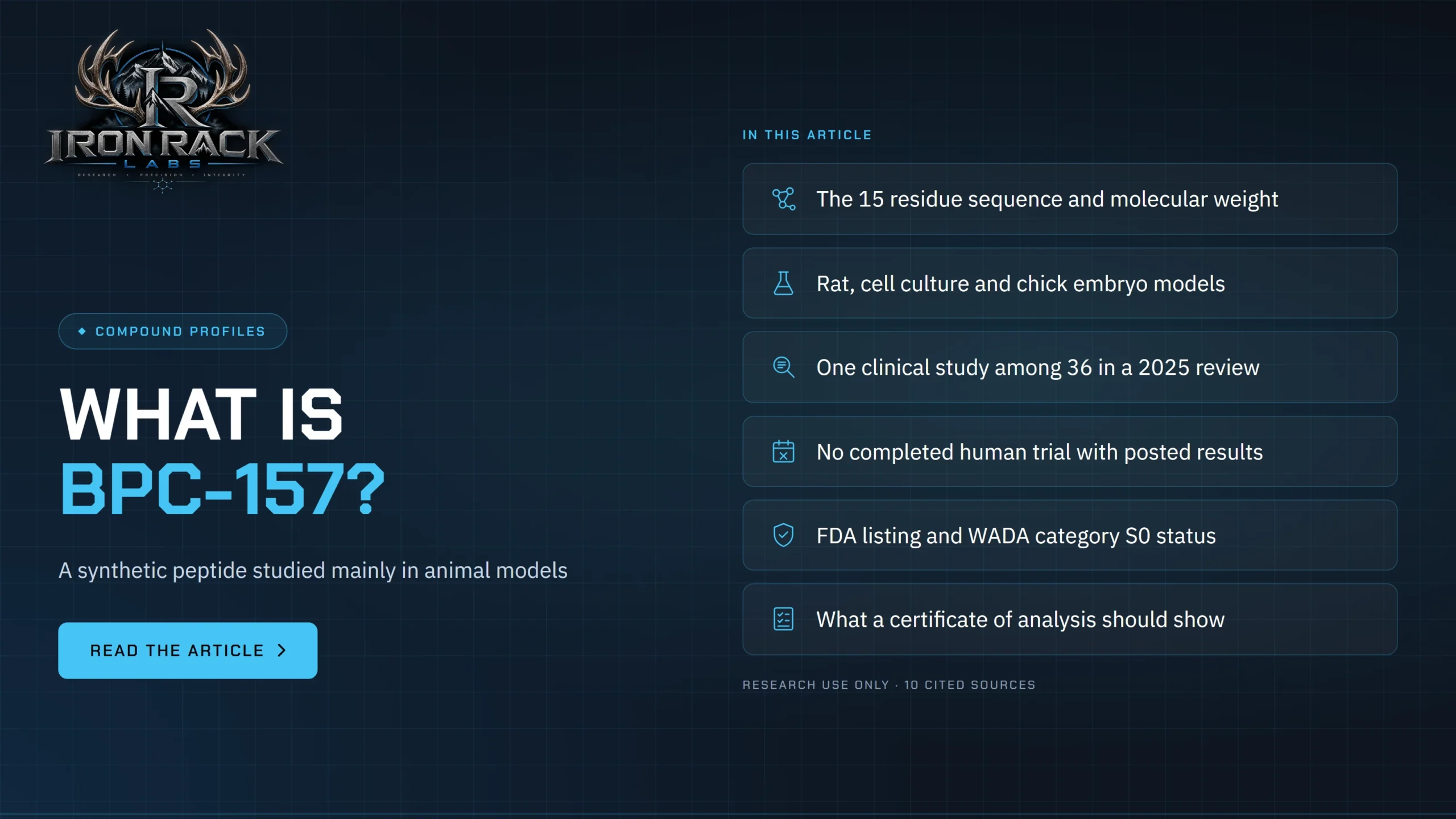
BPC-157 is a synthetic peptide of 15 amino acids. Almost everything published about it comes from cell cultures, rodents and chick embryos, and human data are limited to a few very small reports.
That makes it a well studied research compound in animal models and an unestablished one in people. This article sets out both sides of that line.
BPC-157 is one of the most discussed research peptides, and much of what is written about it online runs well ahead of the literature. This profile goes back to the papers: what the molecule is, how the published research is made up, where the evidence stops, and what a lot record for it should show. Identity and purity are covered in more depth in our explainer on what an RP-HPLC purity number actually measures.
Scope: this article summarizes published laboratory and animal research. It does not describe or recommend use in people or animals, and the research use policy sets out how materials on this site are supplied.
What BPC-157 is, chemically
BPC-157 is a pentadecapeptide, meaning a chain of 15 amino acids. A 2025 literature and patent review by Józwiak and colleagues gives its sequence as Gly-Glu-Pro-Pro-Pro-Gly-Lys-Pro-Ala-Asp-Asp-Ala-Gly-Leu-Val and its molecular weight as 1,419.55 daltons. The same review credits Sikiric and colleagues with the first description of the peptide in 1993.
- Gly
- Glu
- Pro
- Pro
- Pro
- Gly
- Lys
- Pro
- Ala
- Asp
- Asp
- Ala
- Gly
- Leu
- Val
One letter code
Written in single letters, the sequence reads GEPPPGKPADDAGLV. This is the string a certificate should match, read from the N terminus.
The proline run
Positions 3 to 5 are three prolines in a row. The 2025 review discusses repeated proline motifs as a structural feature associated with resistance to nonspecific proteolysis.
A fragment, not a protein
The 15 residue chain is a partial sequence of a larger protein, and a result on the fragment is not a result on that protein.
That larger protein is reported from human gastric juice, a history summarized in the 2025 review. The material used in research is made by chemical synthesis, which is why its identity has to be confirmed lot by lot rather than assumed.
How the published BPC-157 literature is made up
The literature is large, but it is almost entirely preclinical. A 2025 systematic review in the HSS Journal screened 544 articles published between 1993 and 2024 and included 36 studies. Thirty five were preclinical and one was clinical, and the reviewers rated the whole body of evidence as level IV and level V, the two lowest tiers.
In vitro means cells or tissue in a dish. An animal model means a living animal, most often a rat. A chick embryo assay is a separate system again. Each type answers a narrow question about its own system, and none of them is a human finding.
- Rodent models. Most of the preclinical papers use rats or mice. A result from a rodent model describes that model and its conditions only.
- Cell and tissue culture. In vitro papers expose cultured cells or tissue explants to the peptide under controlled laboratory conditions. They describe a dish, not a living organism.
- Chick embryo assays. A smaller group of papers uses the chick chorioallantoic membrane, an embryonic system with its own limits.
This article deliberately does not summarize individual study outcomes. Those papers report measurements made in their own models, they do not show that the same effects occur in any other species, and they are not a basis for use outside the laboratory.
Where the evidence stops
The main gap is human data, and the gap is wide. These are the points where the published record runs out.
- No completed controlled human trial with results. A Phase I, placebo controlled study in 42 healthy volunteers was registered on ClinicalTrials.gov in 2015. The registry lists no posted results, and Józwiak and colleagues report that submission of the results was cancelled in 2016.
- The human reports that exist are very small. The single clinical study in the HSS review was a retrospective report of 12 people, and the reviewers found no clinical safety data. A 2025 pilot study by Lee and Burgess followed 2 participants with no control group. Reports of this size cannot establish safety or effect.
- Pharmacokinetic data come from animals. The 2025 review describes rapid degradation in animal work, with an elimination half-life under 30 minutes. Comparable human data are not available.
- The models are narrow. Most studies use rats and mice, and the review points out the obvious differences between rodent and human physiology.
- The mechanism is unresolved. Nitric oxide and VEGFR2 signaling come up repeatedly in the mechanistic papers, but Józwiak and colleagues conclude that the mechanism of action, efficacy and safety profile remain unknown.
Regulatory status
BPC-157 is not an approved drug in the United States. On its page of bulk drug substances that may present significant safety risks, in the version current as of April 22, 2026, FDA lists BPC-157 and points to possible immunogenicity, peptide related impurities and difficulty characterizing the active ingredient. The agency states that it lacks sufficient information to know whether the substance would cause harm when administered to humans. FDA revises that page, so check the current version.
In sport, the U.S. Anti-Doping Agency notes that BPC-157 is prohibited under category S0, non-approved substances, of the World Anti-Doping Agency Prohibited List, and that it is not approved for human clinical use by any global health authority.
Why a BPC-157 vial needs its own evidence
Every finding above was produced with a defined sequence. Whether a particular vial holds that sequence, and what else is in it, is an analytical question that the literature cannot answer.
Two points are often missed. First, a mass result near 1,419.5 daltons confirms one property of the material. It does not prove the sequence on its own, because different chains can share a mass. Second, an HPLC purity figure is a ratio of peak areas under one method and one set of conditions, and it says nothing about what the other peaks are. FDA’s concern about peptide related impurities, noted above, is the regulatory version of the same point: the record has to describe the lot, not the molecule in general.
Handling matters after testing too. A lot that tested clean can still degrade if it sits warm or damp, which is covered in our article on cold chain and why the storage temperature is on the label.
What a BPC-157 certificate should show
A certificate of analysis links one lot to one set of test results. For BPC-157, these are the fields to read against the sequence and mass given above.
- Sequence stated as GEPPPGKPADDAGLV
- Expected molecular weight near 1,419.5 daltons
- Measured mass reported next to the expected value
- HPLC method, column and detection wavelength named
- Purity figure tied to a specific lot number
- Lot number on the certificate matches the vial label
- Testing laboratory and test date identified
- Salt form or counterion stated
Our guide on how to read a certificate of analysis walks through a full certificate section by section. Iron Rack Labs publishes lot matched certificates in the certificate of analysis library, and the quality and testing page explains which tests are run on each lot. Pick a BPC-157 lot record there and read it against the list above.
- A synthetic 15 amino acid peptide, sequence GEPPPGKPADDAGLV
- Published work is mostly rat, cell culture and chick embryo models
- One clinical study among 36 in a 2025 systematic review, plus a 2 person pilot
- Mechanism, efficacy and safety in humans remain unestablished
- Not an approved drug in the US, and prohibited in sport under WADA category S0
- Identity and purity belong to a specific lot record
Frequently asked questions
BPC-157 is a synthetic peptide of 15 amino acids with the sequence GEPPPGKPADDAGLV and a molecular weight of about 1,419.5 daltons. It is a partial sequence of a larger protein reported from human gastric juice, and in the published literature it is a research compound studied mainly in cell and animal models.
The sequence is taken from a larger protein reported in human gastric juice, but the 15 residue material used in research is made by chemical synthesis. The fragment and the parent protein are different molecules, so a result on one should not be read as a result on the other, and identity has to be confirmed for each lot.
Only in a very limited way. A 2025 systematic review found one clinical study among 36 included studies, and no clinical safety data. A registered Phase I trial has no posted results, and a 2025 pilot followed only 2 participants without a control group. None of this establishes safety or effect in people.
No. BPC-157 is not an approved drug. FDA lists it among bulk drug substances that may present significant safety risks, citing possible immunogenicity, peptide related impurities and limited safety information. It is also prohibited in sport under category S0 of the World Anti-Doping Agency Prohibited List.
It should state the sequence, the expected and measured mass, the HPLC method and conditions behind the purity figure, the lot number, the testing laboratory and the test date. A purity number with no method or lot attached cannot be checked. The lot number on the certificate should match the vial it is meant to describe.
- Józwiak M, Bauer M, Kamysz W, Kleczkowska P, 2025. Pharmaceuticals, 18(2), 185. DOI
- Vasireddi N, Hahamyan H, Salata MJ, Karns M, Calcei JG, Voos JE, Apostolakos JM, 2025. Systematic review. HSS Journal, 21(4). DOI
- Registry record NCT02637284. ClinicalTrials.gov, first posted December 22, 2015. View source
- Lee E, Burgess K, 2025. Pilot study. Alternative Therapies in Health and Medicine, 31(5), 20 to 24. PubMed
- Certain Bulk Drug Substances for Use in Compounding that May Present Significant Safety Risks. U.S. Food and Drug Administration, content current as of April 22, 2026. View source
- BPC-157 and anti-doping. U.S. Anti-Doping Agency, last modified August 10, 2026. View source
- The Prohibited List. World Anti-Doping Agency. View source
Journal article titles are not reproduced in this list. Each entry links to the original record.
This article is general educational information about published laboratory research. It is not medical, legal or regulatory advice, and nothing in it describes or recommends the use of any compound in people or animals. Materials supplied by Iron Rack Labs are for research use only: not for human or veterinary use, not for diagnostic use, and not for use as a food, drug, dietary supplement or cosmetic. Sale is restricted to adults aged 18 or over. Iron Rack Labs publishes this Journal and supplies research materials, and nothing in this article is an offer, a recommendation or an instruction for use. See the compliance overview for details.